

-
By Zaid Khan
-
October 23, 2026
- 0 Comment
Pipe Bevel Cutting Machines: How They Work and When You Need One
Every pipe weld starts long before the welder strikes an arc. It starts at the pipe end.
If the bevel angle drifts, the root gap changes. If the root face is uneven, the root pass burns through in one spot and lacks fusion in another. If the saddle on a branch connection is cut by eye, the fitter spends an hour grinding it to sit right. All of that shows up later as slow welding, radiography repairs and missed project dates.
Most fabrication shops still prepare pipe ends the same way they did 20 years ago: a hand torch, a grinder and a skilled fitter. That works until volume goes up, the client starts inspecting every bevel or the skilled fitter leaves.
This guide explains what a pipe bevel cutting machine does, how a CNC machine cuts bevels and saddles that no hand torch can match, how it compares with the other ways to bevel pipe and the clear signs that your shop has outgrown manual end prep.
What a pipe bevel is and why its geometry matters
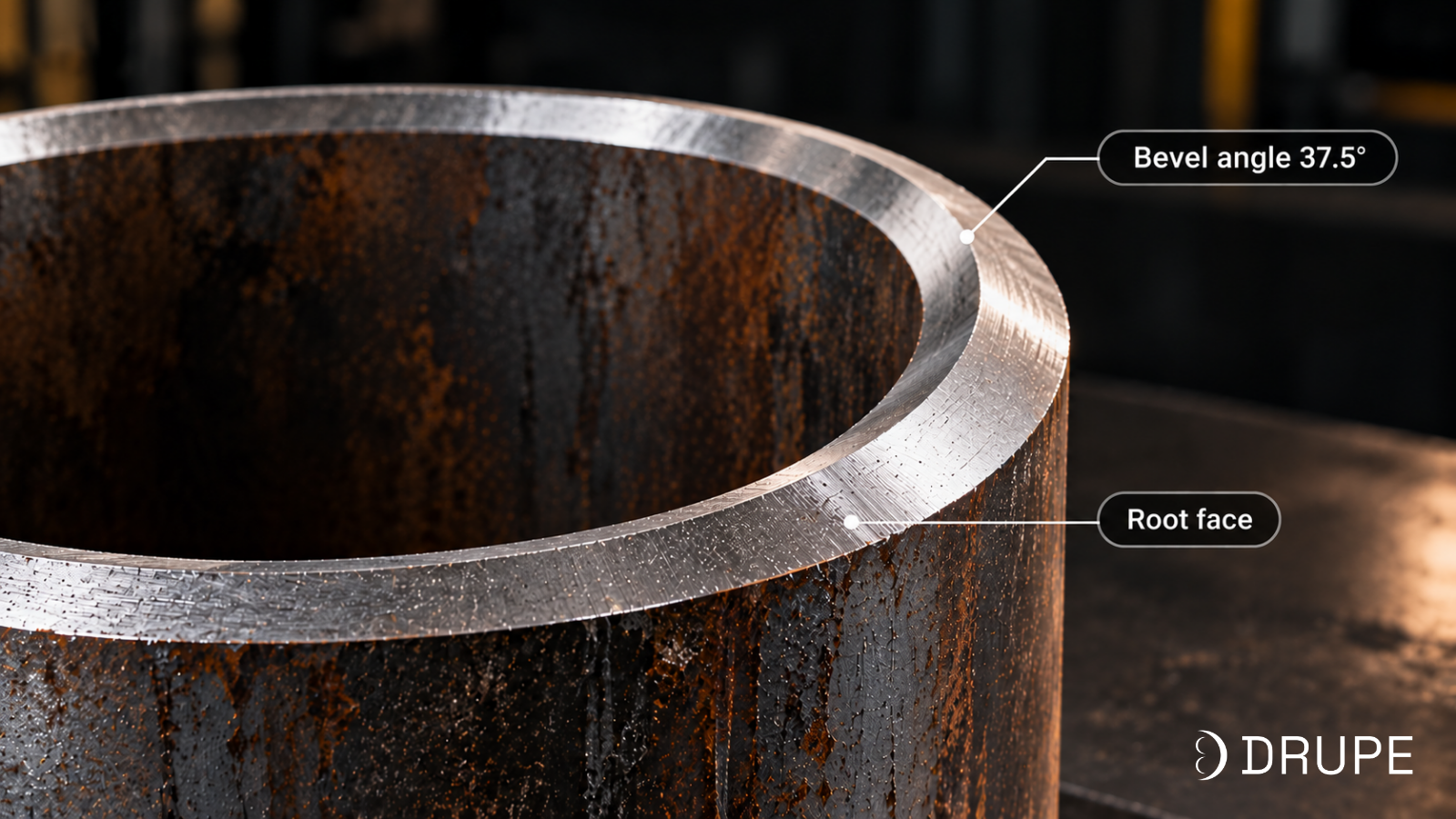
A bevel is the angled edge cut on a pipe end so two pipes can be butt welded with full penetration. Put two bevelled ends together and they form a V-shaped groove. The welder fills that groove from the root at the inside of the pipe to the cap on the outside.
Three dimensions decide whether that weld goes smoothly:
- Bevel angle: the slope of the cut face. Too steep and the welder cannot reach the root. Too shallow and you waste filler metal and time.
- Root face (land): the small flat at the bottom of the bevel. It stops the root pass from burning through. If it varies around the circumference, so does root quality.
- Root gap: the space between the two pipes at fit-up. It depends directly on how square and consistent the bevels are.
Common pipe bevel profiles
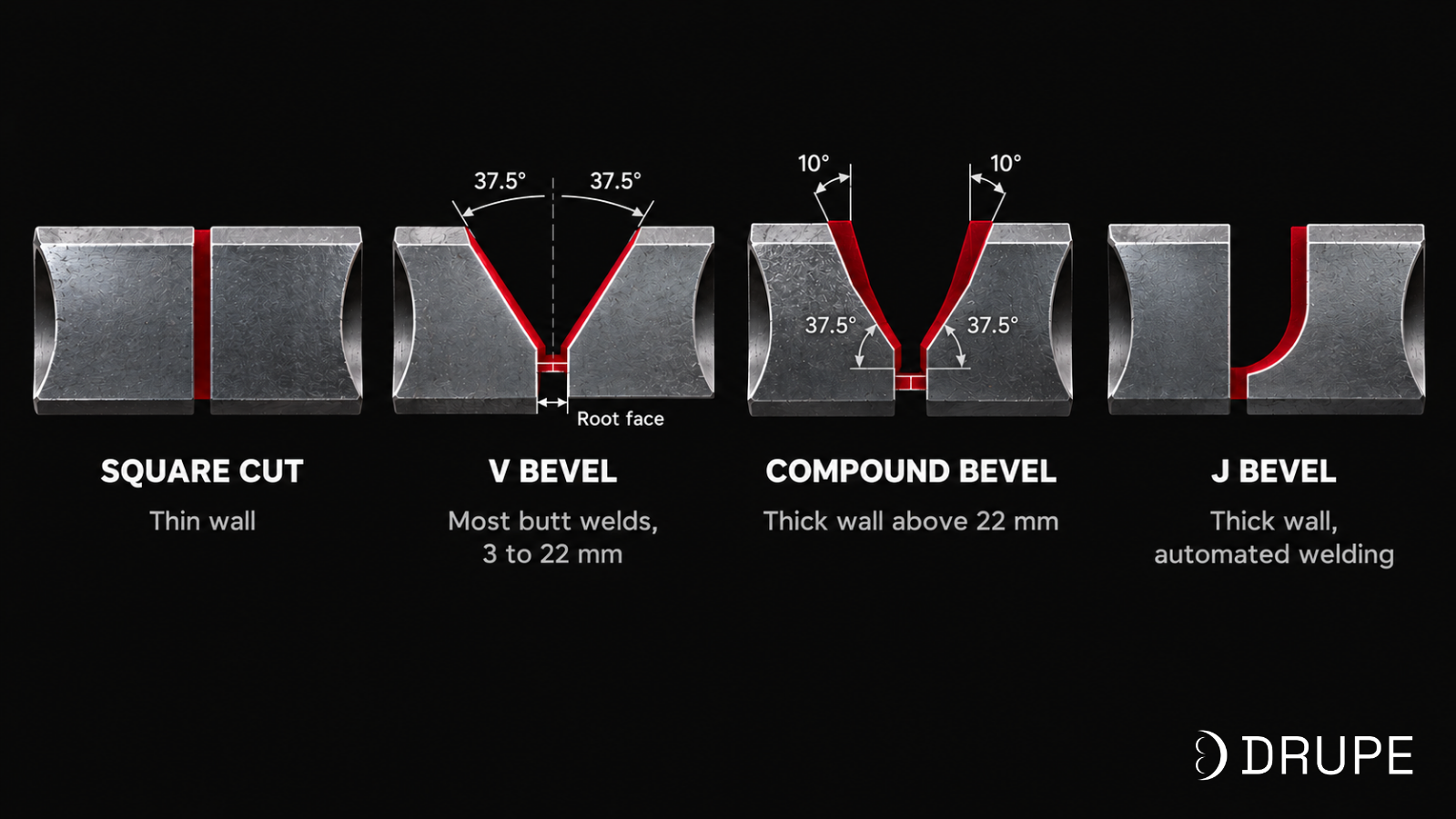
| Profile | Typical use | Typical geometry |
| Square cut | Thin-wall pipe, about 3 mm and under | No bevel, or a light chamfer |
| Standard V bevel | Most butt welds, wall about 3 to 22 mm | 37.5° ± 2.5° with a 1.6 mm ± 0.8 mm root face (ASME B16.25) |
| Compound bevel | Thick wall, above about 22 mm | 37.5° near the root, changing to 10° for the rest of the wall (ASME B16.25) |
| J bevel | Thick-wall and critical welds, often automated welding | A curved groove bottom with a narrow included angle |
| Saddle (fish-mouth) with bevel | Branch connections, headers, manifolds, tubular structures | A 3D intersection curve where the bevel angle changes all the way around |
Always follow the weld procedure specification (WPS) for your job. Client specs and codes can call for different angles and root faces.
A bevel is the angled edge cut on a pipe end so two pipes can be butt welded with full penetration. Put two bevelled ends together and they form a V-shaped groove. The welder fills that groove from the root at the inside of the pipe to the cap on the outside.
Three dimensions decide whether that weld goes smoothly:
- Bevel angle: the slope of the cut face. Too steep and the welder cannot reach the root. Too shallow and you waste filler metal and time.
- Root face (land): the small flat at the bottom of the bevel. It stops the root pass from burning through. If it varies around the circumference, so does root quality.
- Root gap: the space between the two pipes at fit-up. It depends directly on how square and consistent the bevels are.
What a pipe bevel is and why its geometry matters
On thick-wall pipe, a single 37.5° bevel opens a very wide groove at the top. Every extra millimetre of width is filler metal and welding time. A compound bevel keeps the steep angle only near the root and narrows the groove above it.
On a 40 mm wall, that cuts the weld cross-section by roughly a fifth compared with a single 37.5° bevel. Across a project with hundreds of thick-wall joints, that is days of welding time saved. But a compound bevel needs two precise angles on the same pipe end, which is very hard to cut consistently by hand.
Why saddles are the real test
When a branch pipe meets a header, the joint follows a curved 3D path. To give the welder a consistent groove all the way round, the bevel angle on the branch has to change continuously along that curve. A fitter with a hand torch and a paper template can get close. A CNC machine calculates the correct angle at every point and cuts it in one pass.
How a CNC pipe bevel cutting machine works
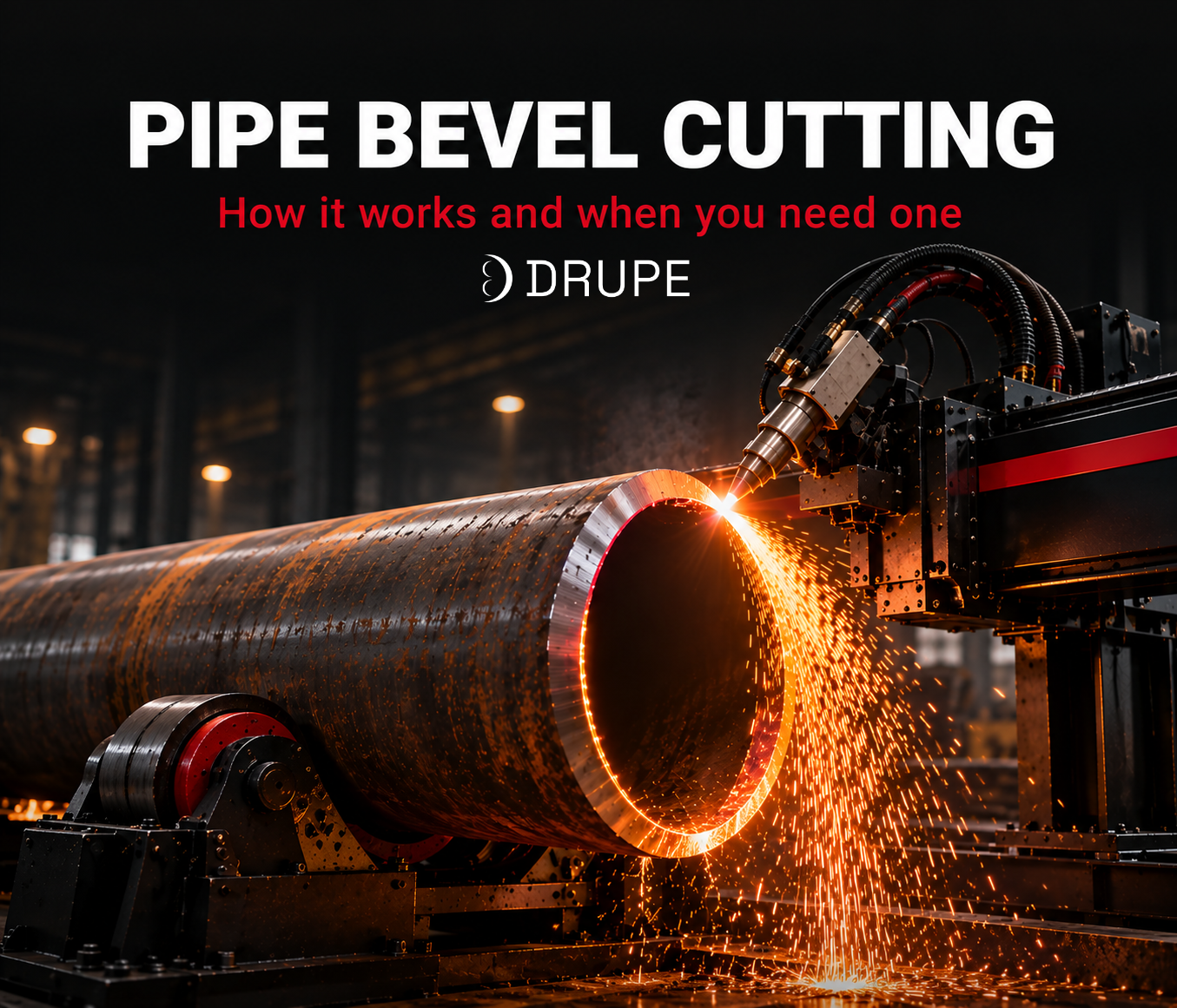
A CNC pipe bevel cutting machine does what a skilled fitter does with a torch, but on several coordinated axes at once. The pipe turns, the torch travels along it, the torch tilts to the bevel angle and its height adjusts to the pipe surface, all under one controller.
The axes that matter
| Axis | What it does |
| Pipe rotation | A chuck or powered rollers turn the pipe so the torch can work around the full circumference |
| Longitudinal travel | The torch carriage moves along the pipe to cut at any position on its length |
| Torch height | Keeps the torch at the right standoff from the pipe surface, even where the pipe is oval or bent |
| Bevel tilt | One or two tilting axes in the bevel head set the torch angle for straight, compound and variable bevels |
Basic machines manage straight cuts and fixed-angle bevels with 3 or 4 axes. Machines that cut saddles with a properly varying bevel angle need 5 or more coordinated axes. That is where 6 and 7 axis machines earn their price.
From drawing to finished pipe end
- Program the part. The operator picks a shape from the software’s library (straight bevel, saddle, hole, mitre, slot) and enters pipe diameter, wall thickness and intersection angles. For bigger projects, part data can come straight from the piping model through CAM software such as Lantek, AlmaCAM or SigmaNest.
- Load the pipe. The pipe sits in a chuck at one end and on support rollers along its length. Heavy, large-diameter pipe rides on powered roller beds instead.
- Sense the surface. Real pipe is never perfectly round or straight. The machine tracks the surface, through arc voltage on plasma or a sensor on oxyfuel, so standoff stays correct as the pipe turns.
- Cut. The controller synchronises rotation, travel, height and tilt. A saddle with a variable bevel that takes a fitter an hour to mark, cut and grind comes off the machine in minutes.
- Clean and fit. Thermal-cut bevels usually get a quick brush or light grind to bright metal before welding, as most weld procedures require.
Plasma or oxyfuel on pipe
The same thickness logic from our plasma vs oxyfuel guide applies to pipe, with one twist. When the torch tilts to cut a bevel, it cuts through more metal than the wall thickness. At 37.5°, a 30 mm wall becomes about 38 mm of steel along the cut path.
So plasma suits stainless pipe and carbon steel walls up to roughly 25 mm. Oxyfuel takes over on thick carbon steel walls. Machines built for oil and gas, power and heavy structural work often carry both, so one setup handles the whole pipe schedule.
Two common machine layouts
Rotating-pipe machines turn the pipe under a torch that travels along a beam. They suit most pipe shops, from small bore to around 1.5 m diameter.
Gantry-style machines carry the torch on a gantry over large-diameter pipe or rolled shells on roller beds. They suit very large diameters and heavy tubular structures. Some gantries also cut flat plate on the same bed, which suits shops that cut both.
A CNC thermal machine is not the only way to prepare a pipe end. Each method below has a place. Many good shops use two of them.
| Manual torch and grinder | Portable machining beveller | Stationary end-prep machine | CNC thermal pipe cutting machine | |
| How it cuts | Hand-held oxyfuel or plasma torch, then grinding | Clamps to the pipe and machines the bevel with a cutting tool | Fixed machine that machines the pipe end, lathe-style | Rotating pipe, tilting CNC torch, plasma or oxyfuel |
| Consistency | Depends entirely on the fitter | Very high | Very high | High and repeatable |
| Saddles, holes, mitres | By template, slow | No | No | Yes, with variable bevel |
| Heat-affected zone | Yes, uneven | None (cold cut) | None (cold cut) | Yes, narrow, usually cleaned before welding |
| Speed on thick wall | Slow | Slow | Medium | Fast |
| Capital cost | Very low | Low to medium | Medium | High |
| Best for | Occasional work, repairs, field fixes | Site tie-ins, pipe that cannot be moved, cold-cut specs | High volume of straight ends on small and medium bore | Spool shops, headers, structural tubular, any volume with branches |
Thermal or cold: which do you need?
Most carbon steel pipe is thermally cut and bevelled without issue. A light grind or brush to bright metal removes the oxide before welding.
Cold cutting matters in a narrower set of cases. Some high-alloy and chrome-moly grades either need preheat for thermal cutting or need the heat-affected layer ground off, and some client specifications ban thermal cutting on certain materials altogether. Pipe that is already installed also has to be bevelled in place, which only a portable tool can do.
The practical pattern in busy fabrication shops is simple. Put the volume work, branch connections and thick-wall bevels on a CNC thermal machine. Keep a portable machining beveller for site tie-ins and the few joints where the spec demands a cold cut.
When do you need a pipe bevel cutting machine?
No single number tells you when to buy. But shops that are ready usually show at least two of these six signs.
- You prepare pipe ends every day. If fitters cut and grind bevels as a routine part of every shift, that time adds up faster than most owners realise. The worked example below shows how.
- You cut branch connections. Headers, manifolds, nozzles, tubular trusses and offshore structures all need saddles. Saddles are where manual work is slowest and least consistent. They are also where a CNC machine saves the most time.
- Your weld repairs trace back to fit-up. If radiography rejections cluster around lack of fusion at the root or uneven root gaps, the problem often starts at the bevel, not with the welder.
- You are automating welding. Mechanised welding on rotators or with orbital and submerged arc systems needs consistent joint geometry. Automated welding fed by hand-cut bevels spends its time correcting for them.
- You work on thick wall or large diameter. Above about 20 mm wall or 600 mm diameter, manual bevelling gets slow, physically demanding and hard to keep consistent. Compound bevels are close to impossible to cut by hand to spec.
- Skilled fitters are your bottleneck. If projects wait on the two or three people who can cut a good saddle, a CNC machine turns their skill into a program anyone trained can run.
A worked example
The figures below are illustrative. Replace them with your own shop’s numbers.
Say your shop prepares 25 ends a day on 300 mm (12-inch) pipe with a 15 mm wall. A fitter takes about 35 minutes per end to mark, cut, bevel and grind. A CNC machine takes about 5 minutes per end including loading.
| Manual | CNC | |
| Time per end | 35 min | 5 min |
| Time per day (25 ends) | about 14.5 hours | about 2 hours |
| Skilled fitter time freed per month (25 working days) | about 300 hours | |
That is close to two full-time fitters moved from grinding to fit-up and welding. Add saddles, where the gap between manual and CNC is wider still, plus fewer weld repairs, and the payback case usually becomes clear within a single large project.
When you probably don't need one
A CNC machine is the wrong buy if you bevel only a few pipe ends a week, if almost all your pipe is small bore (under about 50 mm) or if nearly all your work is done on site on installed pipe. In those cases a saw, a portable machining beveller and a good fitter will serve you better for far less money.
What to check before you buy
A CNC machine is the wrong buy if you bevel only a few pipe ends a week, if almost all your pipe is small bore (under about 50 mm) or if nearly all your work is done on site on installed pipe. In those cases a saw, a portable machining beveller and a good fitter will serve you better for far less money.
Spec sheets all look similar. These are the questions that separate a machine that fits your work from one that only fits the brochure.
| Check | Question to ask the supplier |
| Diameter and length | What is the smallest and largest pipe diameter, and the longest pipe, the machine handles without extra supports? |
| Bevel capacity | What is the maximum wall thickness for a 37.5° bevel, not just for a straight cut? |
| Process | Plasma, oxyfuel or both? Which power source, and at what amperage? |
| Pipe weight | What is the maximum pipe weight, and how is a heavy pipe supported and rotated? |
| Bevel types | Can it cut compound bevels and saddles with a varying bevel angle in one pass? |
| Pipe ovality | How does the machine keep the torch at the right height on oval or bent pipe? |
| Software | Which shapes are built in? Can it import part data from our CAD or piping software? |
| Service | Where is the nearest service engineer, and how fast do spare parts arrive? |
| Trial | Will you cut our pipe, at our wall thickness, before we sign? |
The last question matters most. A demonstration on the supplier's own pipe proves the machine runs. A trial on your pipe proves it fits your work.
Where Drupe's pipe cutting machines fit
If you cut heavy pipe for oil and gas, power or process plants, look at the ZAU-PB-1500. It is Drupe’s flagship CNC pipe bevel cutting machine, with plasma and oxyfuel on one machine, for pipe from 150 mm to 1,500 mm diameter and up to 12 tonnes.
If saddles, holes and compound bevels make up most of your work, the T-600 and T-800 are 7-axis bevel cutting machines built for exactly that geometry.
If you work with very large diameters or tubular structures, the TUBE Series gantry handles pipe from 250 mm to 2,000 mm diameter.
If you cut both plate and pipe but have floor space for one machine, the PLUBE Series does both on a single gantry.
Once the bevels are cut, Drupe’s RT Series welding rotators turn the pipe for mechanised welding, so the consistent bevel turns into a consistent weld.
Drupe has built cutting and welding automation since 1992 and designs its own CNC bevel head in India. The mechanics, bevel head, controls integration and software are all done in-house, so one team answers for the whole machine after it is installed.
Talk to Drupe about your pipe work
Send us your pipe diameters, wall thicknesses, materials and roughly how many ends you prepare each month. Our team will recommend the right machine and process. We can also cut a trial on your own pipe before you decide.
Request a pipe cutting trial or write to sales@drupeengg.com.
Frequently asked questions
A pipe bevel cutting machine cuts the angled edge on a pipe end so it can be butt welded with full penetration. CNC versions rotate the pipe while a tilting plasma or oxyfuel torch cuts bevels, saddles, holes and mitres to programmed geometry.
The most common bevel is 37.5° ± 2.5° with a 1.6 mm root face, as set out in ASME B16.25. Two bevelled ends together give a 75° groove. For walls thicker than about 22 mm, B16.25 shows a compound bevel that changes to 10° above the root area. Always follow the weld procedure for your job.
Yes, for most carbon steel pipe. Plasma and oxyfuel bevels are normally brushed or lightly ground to bright metal before welding. Some alloy grades and client specifications restrict thermal cutting or call for preheat or extra grinding, so check your WPS.
Yes. A CNC machine with 5 or more coordinated axes cuts saddles for branch connections and changes the bevel angle continuously around the joint. That gives the welder a consistent groove all the way round, which is very hard to achieve by hand.
A pipe cutting machine cuts pipe to length. A pipe bevelling machine prepares the edge for welding. CNC thermal pipe cutting machines do both in one pass, along with saddles, holes and mitres.
It depends on the process. Plasma typically bevels stainless steel and carbon steel walls up to about 25 mm. Oxyfuel bevels much thicker carbon steel walls. Remember that a bevel cuts through more metal than the wall thickness: at 37.5°, a 30 mm wall means about 38 mm along the cut.
When you prepare pipe ends every day, cut branch connections or work to inspected weld procedures. In those shops, the time freed from manual cutting and grinding, plus fewer weld repairs, usually pays for the machine within a few large projects.