

-
By Zaid Khan
-
October 23, 2026
- 0 Comment
Plasma vs Oxyfuel Cutting: Which Is Better for Your Plate Thickness?
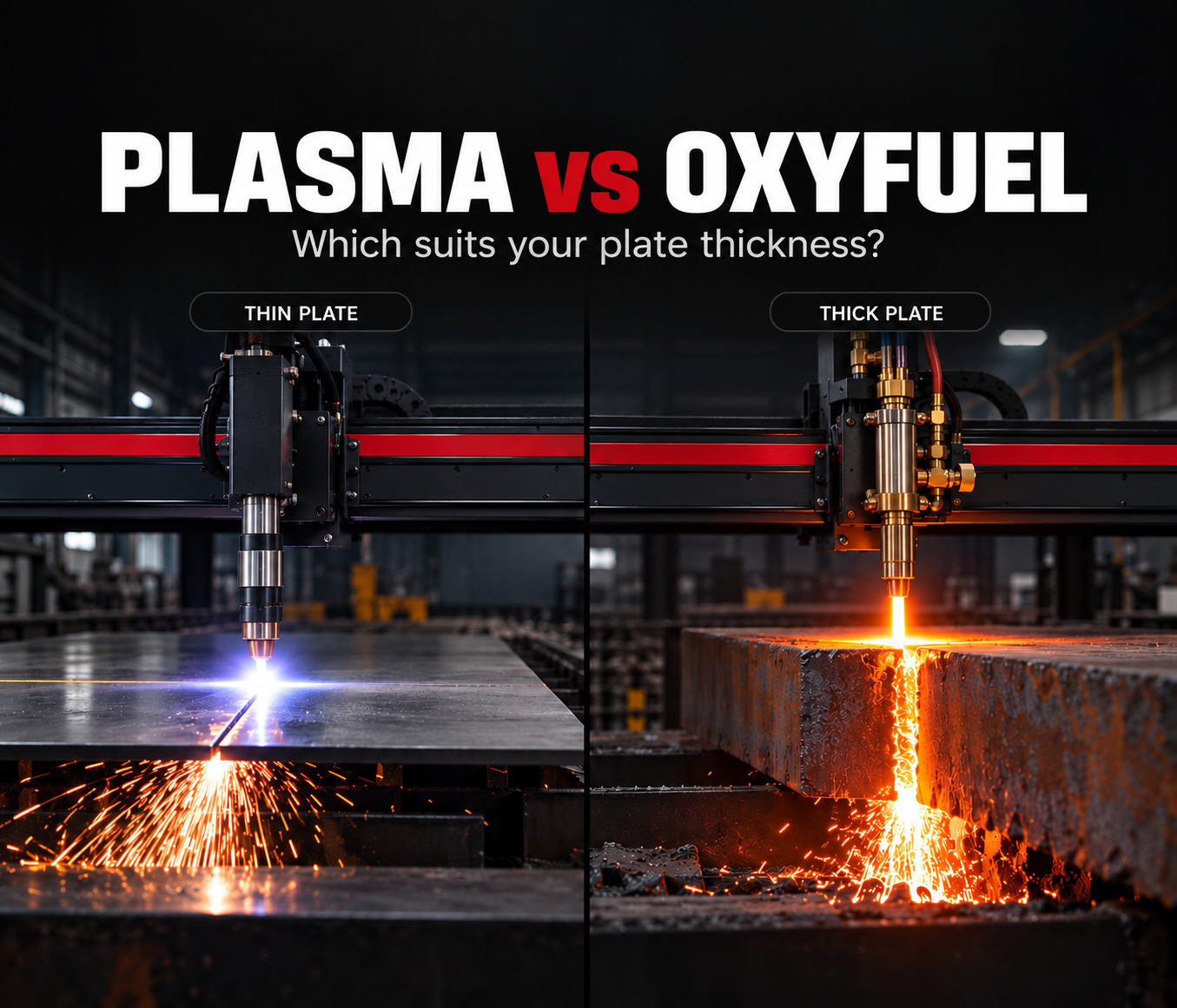
If you cut steel plate for a living, you have probably heard both sides of this argument on your own shop floor. The plasma camp says it is faster and cleaner. The gas camp says nothing beats a torch on heavy plate and the running cost is a fraction.
Both are right. They are just talking about different plate.
The real question is not plasma vs oxyfuel. It is which thickness band most of your work sits in, what materials you cut and how many metres you need to get through in a shift. Get that right and the process choice almost makes itself.
This guide walks through how each process works, where each one wins by thickness, what it really costs per metre and when it makes sense to put both torches on the same CNC machine.
How plasma and oxyfuel cutting actually work
Oxyfuel: burning the steel away
Oxyfuel does not melt steel. It burns it.
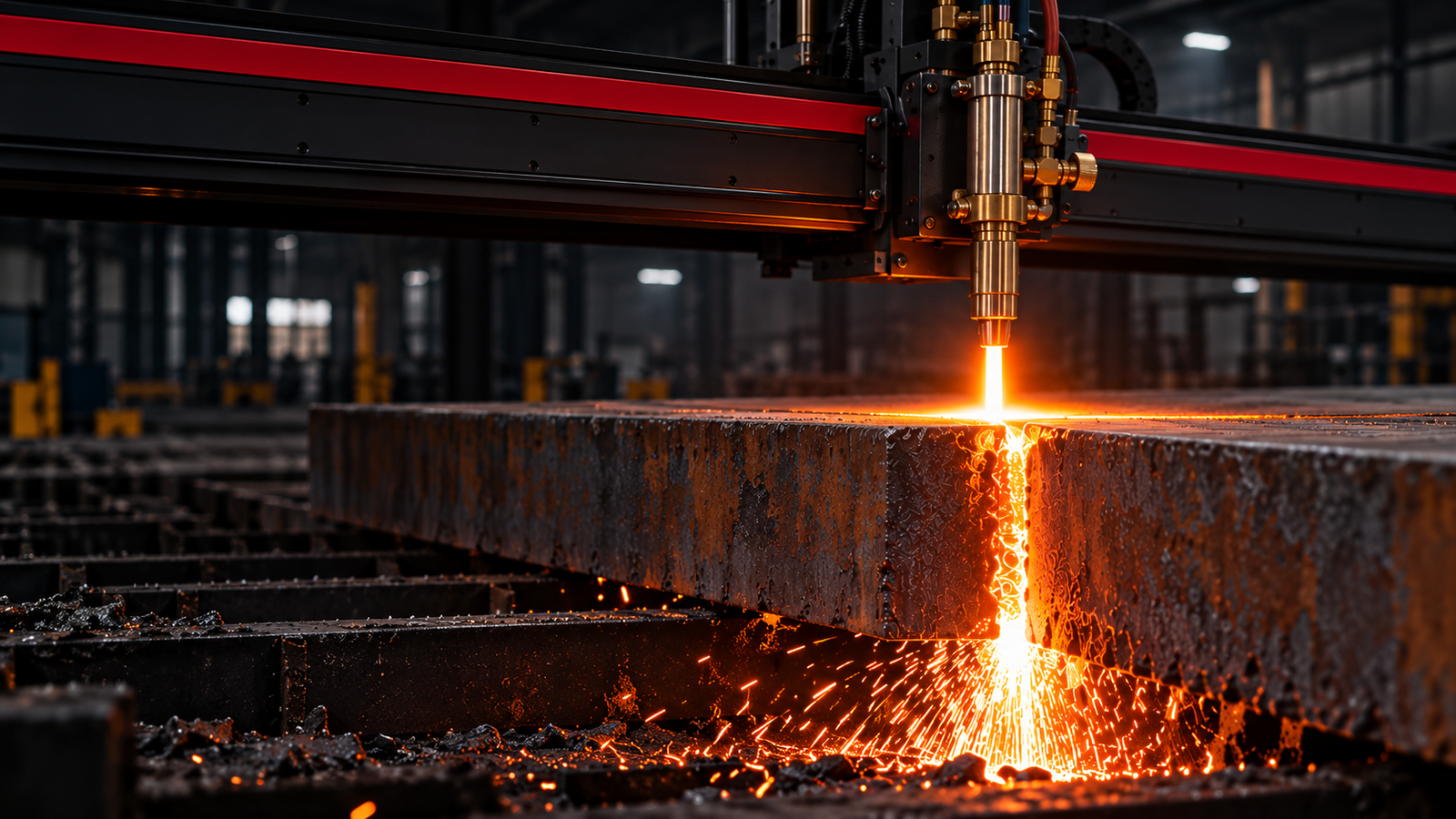
A preheat flame, usually LPG, propane or acetylene mixed with oxygen, heats the plate to its ignition temperature of around 900°C. A jet of pure oxygen is then fired through the centre of the torch. The hot iron reacts with that oxygen, turns into iron oxide and the oxygen stream blows the molten oxide out of the kerf.
That chemistry is what makes oxyfuel so good on thick plate. The reaction itself releases heat, so the cut keeps feeding itself all the way through 100 mm or 200 mm of steel. It is also why oxyfuel only works on carbon and low-alloy steel. Stainless steel and aluminium form oxides that melt at a higher temperature than the base metal, so the reaction stalls.
Plasma: melting the metal with an electric arc
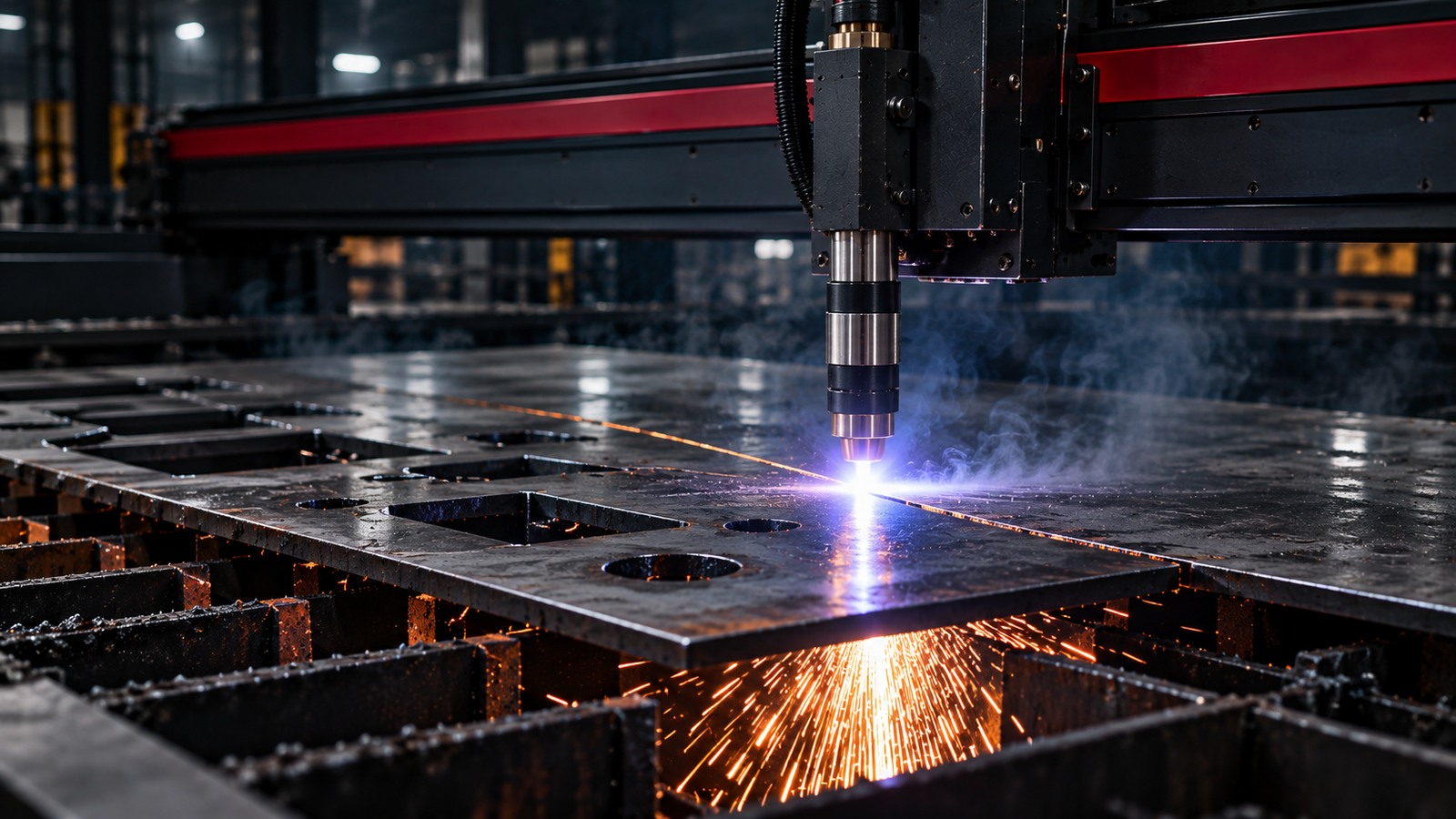
Plasma cutting sends an electric arc through a gas, typically air, oxygen or nitrogen, and squeezes it through a narrow copper nozzle. The gas ionises into plasma at temperatures above 20,000°C. That jet melts the metal and blows it out of the cut.
Because plasma melts rather than burns, it cuts any electrically conductive metal: mild steel, stainless steel, aluminium, copper and brass. Modern high-definition systems hold a narrow, stable arc that gives tight tolerances and clean edges on thin and medium plate.
The trade-off is depth. The arc loses energy as it travels through the plate. Past a certain thickness, the system can no longer pierce reliably from the middle of a sheet and you are limited to starting from the plate edge.
Plasma vs oxyfuel by plate thickness
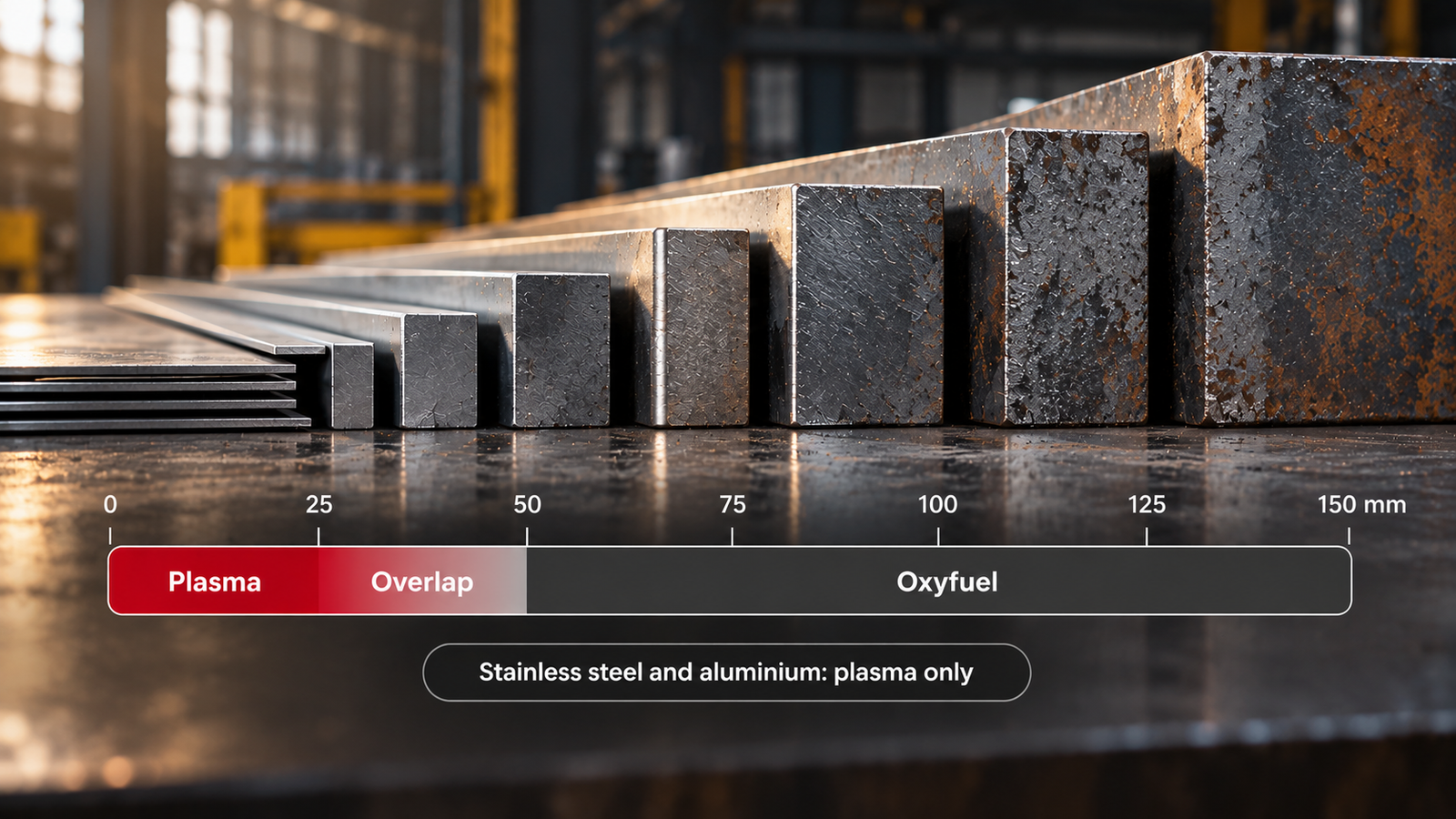
Thickness is the single biggest factor in this decision. Here is how the two processes compare on mild steel, band by band.
| Plate thickness (mild steel) | Better choice | Indicative cut speed, plasma | Indicative cut speed, oxyfuel | Why |
|---|---|---|---|---|
| Under 6 mm | Plasma | 5,000+ mm/min | 600 to 700 mm/min | Oxyfuel puts too much heat into thin sheet, so it warps and the edge rolls |
| 6 to 25 mm | Plasma | 1,400 to 3,000 mm/min | 450 to 650 mm/min | Plasma is 3 to 5 times faster with a narrower heat-affected zone |
| 25 to 50 mm | Overlap | 500 to 1,400 mm/min | 350 to 450 mm/min | Plasma still wins on speed. Oxyfuel wins on edge squareness and running cost, especially with 2 or more torches cutting at once |
| 50 to 100 mm | Oxyfuel | Edge start only, on the largest systems | 230 to 350 mm/min | Most plasma systems cannot pierce this deep. Oxyfuel holds a square edge |
| Above 100 mm | Oxyfuel | Not practical | Under 250 mm/min | Oxyfuel is the only economical thermal option |
| Stainless steel or aluminium, any thickness | Plasma | Depends on amperage | Cannot cut | Oxyfuel chemistry does not work on these metals |
Speeds are indicative for a single torch on mild steel and vary with amperage, gas, tip size and plate condition. Always check against the manufacturer's cut charts for your power source and torch.
Two points the table does not show. First, a 300 A high-definition plasma system pierces up to roughly 45 to 50 mm of mild steel in production. A 200 A system tops out lower. So the plasma column above depends heavily on which power source sits behind the torch.
Second, oxyfuel speed drops slowly as plate gets thicker, while plasma speed falls steeply. That is why the crossover sits where it does. The thicker the plate, the less plasma’s speed advantage is worth.
Beyond thickness: speed, edge quality, cost and materials
| Factor | Plasma | Oxyfuel |
|---|---|---|
| Materials | Any conductive metal: mild steel, stainless, aluminium, copper | Carbon and low-alloy steel only |
| Piercing | Seconds, no preheat | 30 to 90 seconds of preheat on thick plate before each pierce |
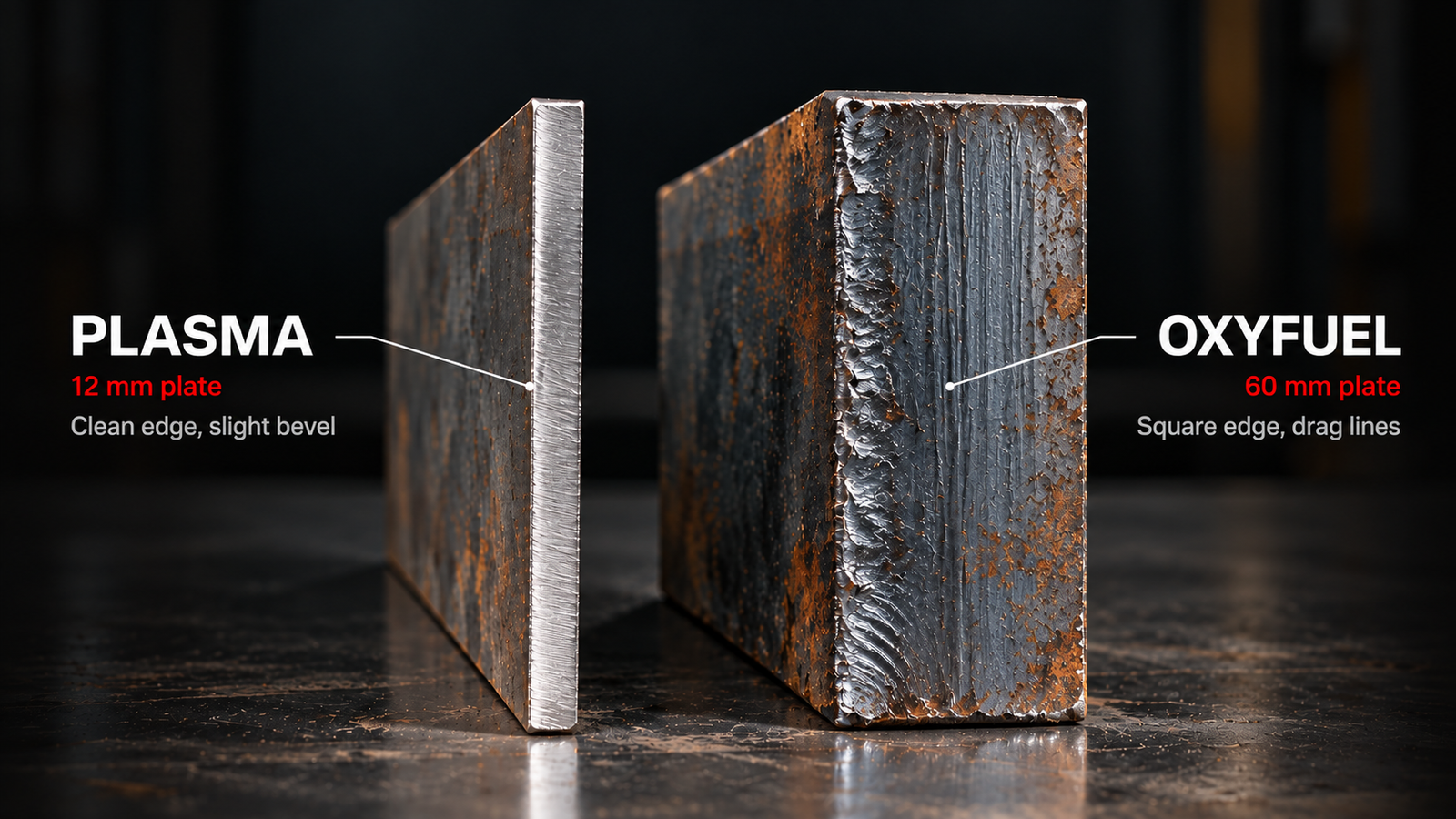
| Edge on thin and medium plate | Clean, minimal dross, small bevel of 1° to 3° | Wider kerf, more slag, risk of warping |
| Edge on thick plate | Bevel angle grows, top edge rounds | Square, consistent edge |
| Heat-affected zone | Narrow | Wide |
| Capital cost | Higher (power source, consumables, extraction) | Lower |
| Running cost per hour | Higher (electricity, electrodes and nozzles) | Lower (oxygen and fuel gas) |
| Multiple torches on one gantry | Usually one torch per power source | 2 to 6 torches can cut identical parts at once |
Cost per metre is the number that matters
Plasma costs more per hour to run. Oxyfuel costs less per hour but cuts slowly. What decides profitability is cost per metre of finished cut, which is hourly cost divided by metres cut in that hour.
On 12 mm plate, plasma can finish 4 to 5 times more metres in an hour. Even with higher consumable and power costs, its cost per metre is clearly lower. On 60 mm plate, plasma is either edge-starting or not cutting at all. A single oxyfuel torch already beats it. Run 3 oxyfuel torches on identical parts and the gap widens further.
Do not forget labour and machine time. A plasma machine that clears a day’s nesting in one shift frees the operator and the bed for the next job. On thin plate that hidden saving often outweighs the consumable bill.
Weld-prep bevels
If your parts go straight to welding, bevel capability matters as much as straight cuts. Plasma bevel heads cut V and Y preps fast on thin and medium plates. On a thick plate, oxyfuel bevel setups with 2 or 3 torches can cut V, Y, X and K preps in a single pass. Either way, a bevel cut off the CNC table removes a separate grinding or machining step and gives the welder a consistent root gap.
Which one should you choose? Start with your plate mix
Pull the last 6 months of cutting jobs and sort them by plate thickness and material. That one exercise answers the question better than any brochure.
More than 70% of your plate is under 25 mm, or you cut stainless or aluminium. Choose plasma. You will cut more parts per shift, spend less on grinding and fit up faster. This is the typical profile of PEB builders cutting webs, flanges and base plates, and of general fabricators.
More than 70% of your plate is carbon steel above 40 mm. Choose oxyfuel. Add multiple torches if you cut repeat parts. This is the typical profile of pressure vessel shops cutting shell plates and tube sheets, and of heavy structural and mining equipment fabricators.
Your work spans both ranges. This is where most heavy fabrication shops actually sit: 8 mm gussets and stiffeners on Monday, 80 mm flanges and base plates on Wednesday. Buying one process means either outsourcing the other half of your work or forcing the wrong process onto it.
The practical answer is one CNC machine carrying both a plasma torch and an oxyfuel torch on the same gantry. The nesting software assigns each part to the right process, the operator loads the plate once and the machine switches torches as the job needs.
Where Drupe's plate cutting machines fit
If your work spans both thickness ranges and you cut full plates at volume, look at the SEM Classic. It is a CNC gantry with a 3 x 6 m cutting area that carries a plasma torch and an oxyfuel torch on the same beam, so 8 mm stiffeners and 80 mm base plates come out of the same nest.
If you need both processes but have less floor space or lower volume, the TB-300 gives you plasma and gas cutting on a smaller table, starting from a 1.5 x 3.5 m bed.
If most of your parts go straight to welding, the Plate Bevel Cutting Machine adds Drupe’s own CNC bevel head to the gantry. V, Y, X and K preps come off the table ready to weld instead of going to a grinder.
Drupe has built cutting and welding automation since 1992. The mechanics, the bevel head, the controls integration and the software are all done in-house, so one team answers for the whole machine after it is installed.
Talk to Drupe about your plate mix
Send us your typical plate thicknesses, materials and monthly cutting volume. Our team will recommend the right process and machine configuration, whether that is plasma, oxyfuel or both on one gantry.
Request a consultation or write to sales@drupeengg.com.
Frequently asked questions
Plasma is better for mild steel up to about 25 mm and for stainless steel and aluminium. Oxyfuel is better for carbon steel above about 40 to 50 mm. Neither is better across every thickness, which is why many fabricators run both.
A 300 A high-definition plasma system pierces roughly 45 to 50 mm of mild steel in production and can edge-start thicker plate. Lower-amperage systems cut less. For regular work above 50 mm, oxyfuel is the more reliable and economical choice.
CNC oxyfuel routinely cuts carbon steel from about 6 mm up to 300 mm. Special torches go thicker still. It is most efficient above 25 mm, where its square edge and low running cost pay off.
No. Oxyfuel relies on iron burning in oxygen. Stainless steel and aluminium form oxides that melt at a higher temperature than the metal itself, so the cut cannot continue. Use plasma for these materials.
Oxyfuel is cheaper per hour, but plasma is usually cheaper per metre on plate under 25 mm because it cuts several times faster. Above 40 to 50 mm, oxyfuel is cheaper on both counts.
Yes. Many CNC gantry and table machines carry a plasma torch and one or more oxyfuel torches. The nesting software assigns each part to the right process, so one machine covers thin and thick plate without a second setup.